


4.1 Fourier’s law: exercise 3 (example)
Course subject(s)
4. First step into heat and mass transfer
ELECTRICAL WIRING
Electrical wiring is used all over the world to easily transport energy from place to place. A disadvantage of transporting energy by electrical wires is that the resistance in the wires turn electrical energy into heat (I2R loss). Because of these heat losses, the wiring can become quite hot.
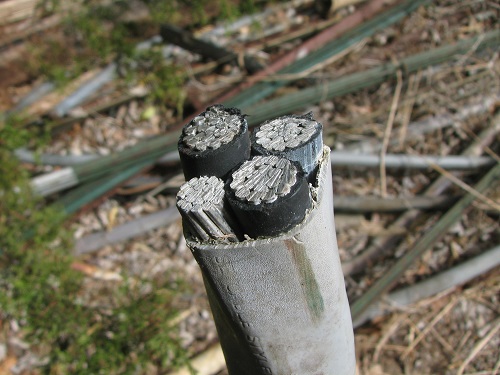
In this exercise, we are examining a copper (λ = 400 W/m°C) wire which we assume to be perfectly insulated all around, so there are no heat losses in the radial direction (take just 1 wire, not 4 stacked as is shown in the picture). Heat is produced uniformly throughout the whole wire, resulting in a total heat production in the cable of 20 W. To prevent the wire from becoming overly hot, it is cooled at both ends, which results in it having a constant temperature of 0 °C at the ends. The length of the wire is 200 meters and the diameter equals 25 centimeters.
Make a sketch of this situation!
You can check your sketch by comparing it to the one we made. You can get a full screen image of the sketch by clicking on the picture below. It is important that you try it by yourself before looking at our version!


The Basics of transport phenomena by TU Delft OpenCourseWare is licensed under a Creative Commons Attribution-NonCommercial-ShareAlike 4.0 International License.
Based on a work at https://ocw.tudelft.nl/courses/basics-transport-phenomena/.