


6.2.2 Virtual Reality/Mixed Reality
Course subject(s)
Module 6 – The Full Picture
While digital design replaces physical media by digital representations, Virtual Reality goes a step further and also excludes the ‘Real World’, often using head mounted displays in order to do so. We used such ‘goggles’ in the feedback video of the second week. VR allows a complete focus on the digital model world. The designer is fully immersed and the diagram below shows this by fencing the real world off with a dark red hashed line.
Of course the real world still exists, but in VR it can only be experienced as a representation. Therefore VR can be seen as the ultimate representation. The trend towards ‘ultimate representation’ started long ago with the invention of drawings, notes, pictures, scale models, maps and contextual models. It is a trend of separation from the building site. Architects work increasingly remotely from their building site. The site can be at the other side of the world and needs to be represented in photos, drawings and models that exist in the office or in the ‘cloud’.

The feedback video of the second week showed VR from a ‘third person’s perspective’: it was not the view from me or you, but it was ‘he’ the person using the goggles. We did this by using a ‘Mixed Reality’ studio. The feedback video shows ‘what it is like to be in VR’.
Mixed Reality can be seen as a phoney compromise to Virtual Reality in multimedia representations. If you really want to experience VR, you will need (to find someone with) a ‘6DOF VR set‘ that shows you the world in a responsive stereoscopic way. The 6DOF system gives you six Degrees Of Freedom, to move and rotate in all directions (forward/back, up/down, left/right, yaw, pitch, roll, or in math notations: XYZ αβγ). Another good and affordable alternative is a Cardboard Viewer, that supports 3DOF (the rotations when you look around).
The mixed reality in our views have been VR images split into a semi transparent front view and a background view, with a chroma key video from the presenter superimposed in between those two layers of VR video. We added funny fake eye’s on the front of the Head Mounted Display, because that helped showing the view direction.
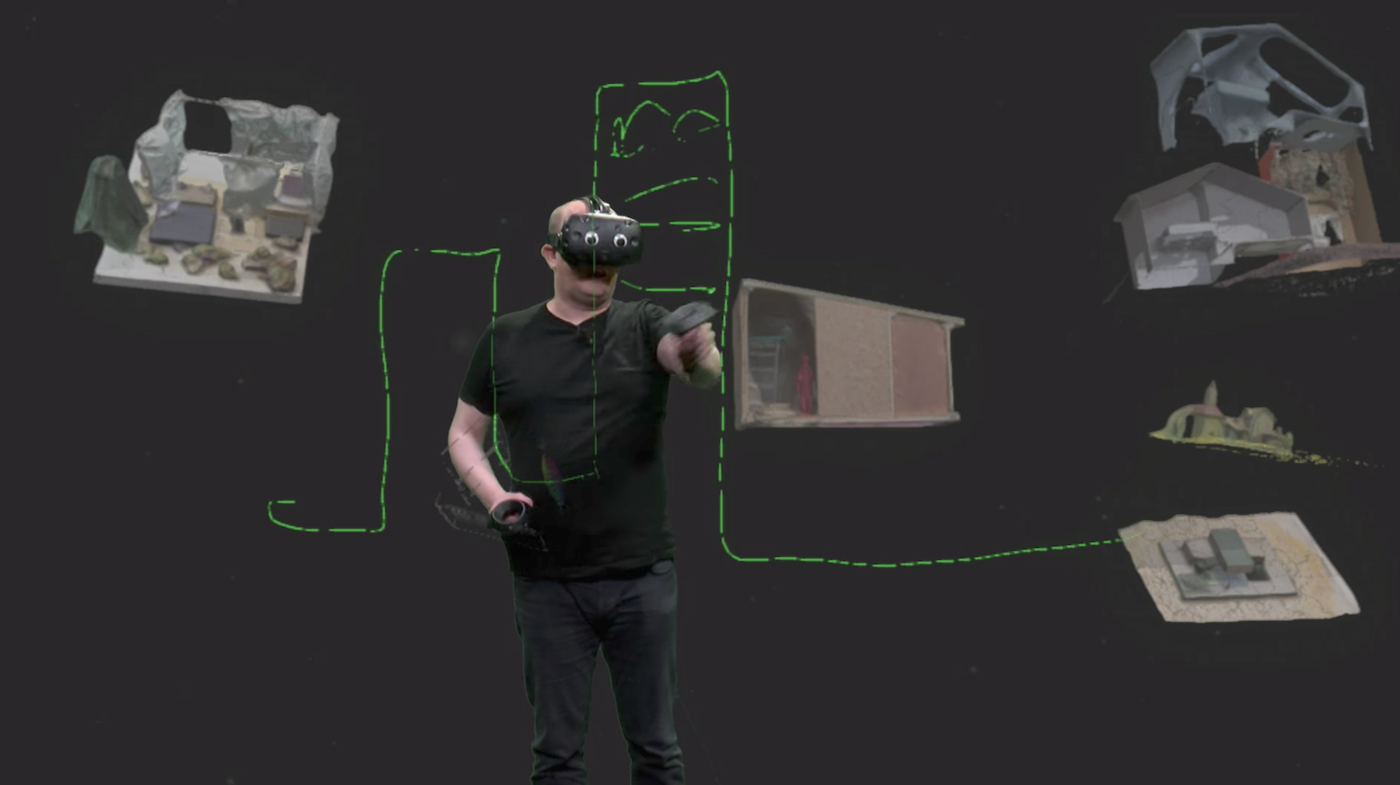
Martijn in a screenshot from the Feedback Video – Week 2.

Models in Architecture by TU Delft OpenCourseWare is licensed under a Creative Commons Attribution-NonCommercial-ShareAlike 4.0 International License.
Based on a work at https://ocw.tudelft.nl/courses/models-architecture-design-physical-digital-models/.