


6.2.3 Full Reality/Augmented Reality
Course subject(s)
Module 6 – The Full Picture
Up until this final week, we have so far not discussed Augmented Reality, but you probably know it from the viral trend that happened in June – September 2016, when the world was invaded by Pokemon Go figures.
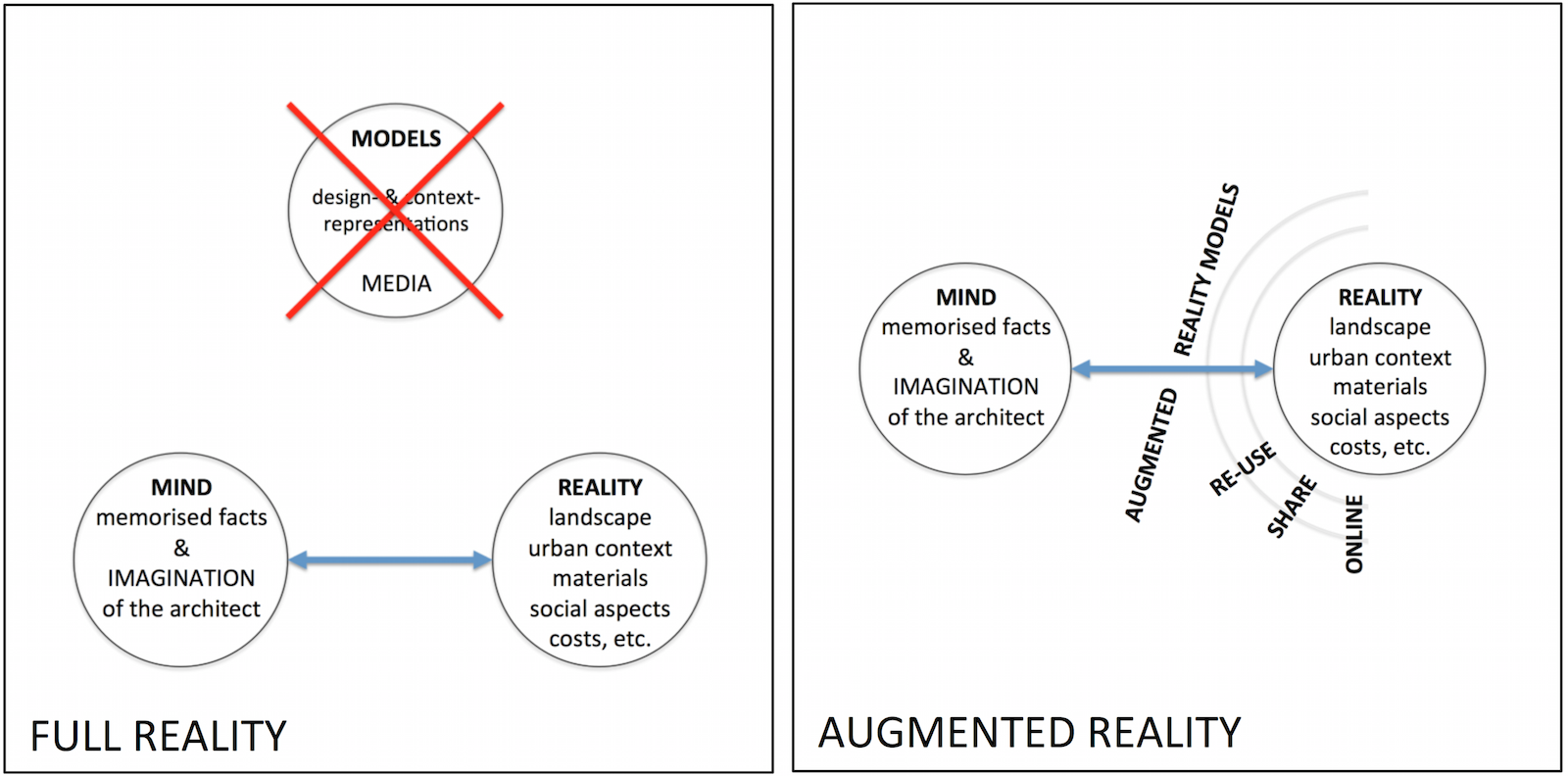
The final two configurations that we would like to compare using diagrams are Full Reality (FR) and Augmented Reality (AR).
Full Reality is when we leave our phone and other devices at home and we go out without any other media. It is almost unimaginable, just being there without even the urge to note things down without a pen and without the possibility of taking a picture. It has become so special that some people need to use the word ‘mindfulness’ to describe the state in which we are just ‘being within the real world’.
It is remarkable that the trend of mindfulness emerges in parallel with Augmented Reality in which the model-world is placed between our minds and the real world. To make this even more worrisome or, perhaps, fascinating, we can think about the unstoppable ubiquity of screens. The cinematic big screen changed into a TV screen, a PC screen, a tablet screen, a mobile smart phone screen a VR or AR headset screen, a contact lens, an implanted artificial retina, and then that screen might emerge to finally become one with our occipital lobe. The trend is obvious: smaller, closer to the eye, in the eye, into our visual processing centre of the brain.


Models in Architecture by TU Delft OpenCourseWare is licensed under a Creative Commons Attribution-NonCommercial-ShareAlike 4.0 International License.
Based on a work at https://ocw.tudelft.nl/courses/models-architecture-design-physical-digital-models/.