


Example 1: Wind gusts around a building
Course subject(s)
1. Introducing Mathematical Modelling
One of the buildings of the Delft University of Technology is the EWI building. It houses the faculty of Electrical Engineering, Mathematics and Computer Science. The 1960s’ building is slender and 22 stories high, as high as possible to allow for good antenna reception on the roof. Unfortunately, in stormy weather, there are very strong winds around the building. Below you see videos of this dangerous situation. Nowadays, when the wind is too strong, attendants tell bikers to dismount and walk.
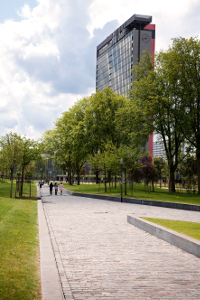
Another video about the wind: More fun around the EWI building in stormy weather.
Would planting more trees help to reduce the wind speeds?
Saša Kenjereš and Benjamin ter Kuile made a mathematical model that describes wind velocities over a city landscape. With that model, they simulated the wind gusts around the EWI building, with and without extra plants and trees [ link to the scientific paper]. It turns out that extra vegetation does decrease the wind speeds significantly!
Note that this model is way more complicated than the model you are going to make in this course. The differential equations used here are partial differential equations instead of the ordinary differential equations of the course (partial differential equations contain partial derivatives instead of `just’ ordinary derivatives). And also advanced numerical methods and computer graphics have been used to produce these results.

Mathematical Modeling Basics by TU Delft OpenCourseWare is licensed under a Creative Commons Attribution-NonCommercial-ShareAlike 4.0 International License.
Based on a work at https://online-learning.tudelft.nl/courses/mathematical-modeling-basics/.