


1.2.1 Roadmap for RRI
Course subject(s)
Module 1. RRI roadmap and KPIs for companies
Please recall:
The overarching goal of the PRISMA project is to help companies implement Responsible Research and Innovation (RRI) in their innovation and social responsibility strategies, and to provide evidence on how RRI can improve their innovation processes and products and help companies to gain trust from society and build resilience, thus strengthening their position on the market.
Research and Innovation (R&I) constantly lead to the development of new technologies, that can have a significant impact on people’s everyday life, the communities and territories, the whole economy and society. The more these technologies enable improvements or change paradigms, the greater can their impacts be. RRI provides a way to address the needs and concerns of people and society and to develop processes, products and services aiming to positive societal impacts, guiding innovation towards sustainable development goals.
Based on the experience in eight pilots with companies active in different sectors and technologies, PRISMA developed a practical guideline/roadmap for companies aiming to strengthen consideration of ethical, legal and social impacts (ELSI) aspects in their technology and product development.
We will now explain how this roadmap works (what is the process to define this document?) in the next reading and the next animation (you may also start with the animation). We will also show the roadmaps for our 8 pilots with industries.
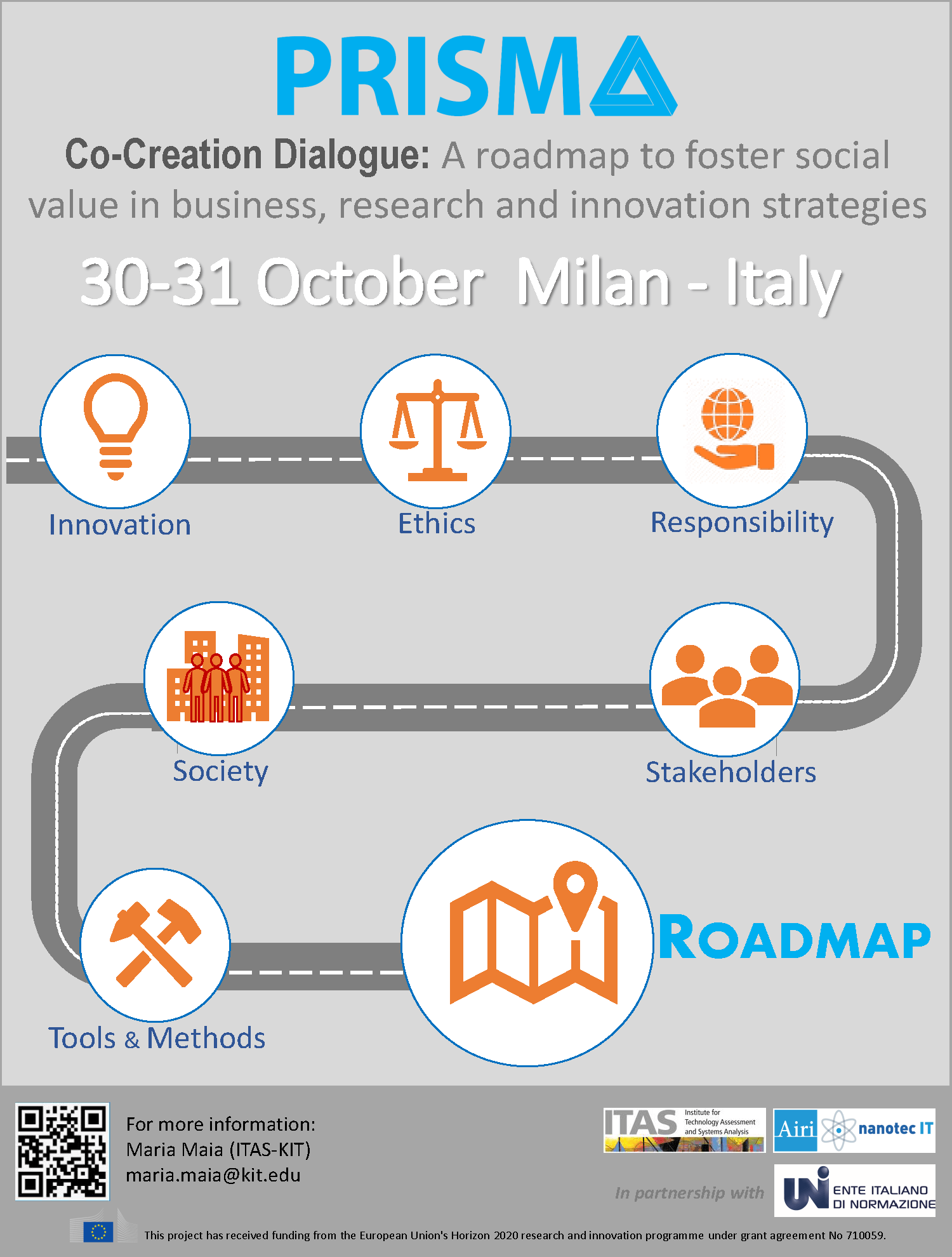
We start with a reading. Have a close look at our roadmap and check your understanding of the RRI-principles we introduced in the previous module.
Note: If you have little time, then focus on Chapter 4 (RRI-principles) and 6 (the actual ‘Framework’.).
Some remarks:
-
- The methodology to build a roadmap is also explained in the animation in the next section.
- The PRISMA exemplary roadmap is structured on a set of acknowledged RRI principles, that are operationalized based on three key actions (see chapter 4, this is key for understanding the process):
1. Integrate analysis of ethical, legal and social impacts since the early stages of product development (Reflection and Anticipation)
2. Perform stakeholder engagement to inform all phases of product development (Inclusiveness)
3. Integrate monitoring, learning and adaptive mechanisms to address public and social values and normative principles in product development (Responsiveness)

Responsible Innovation: Building Tomorrow’s Responsible Firms by TU Delft OpenCourseWare is licensed under a Creative Commons Attribution-NonCommercial-ShareAlike 4.0 International License.
Based on a work at https://online-learning.tudelft.nl/courses/responsible-innovation-building-tomorrows-responsible-firms/.