


4.2.5 Selecting a Statistical Method
Course subject(s)
Module 4. Data Collection & Analysis
When doing statistics, it is important that you use the correct statistics. As with any algebraic manipulation the adage “Garbage In means Garbage Out” also applies to the use of statistics. Hence, it is important that you select the correct method for your analysis. The flow chart below may be of use to you in this. It is also available as a download.
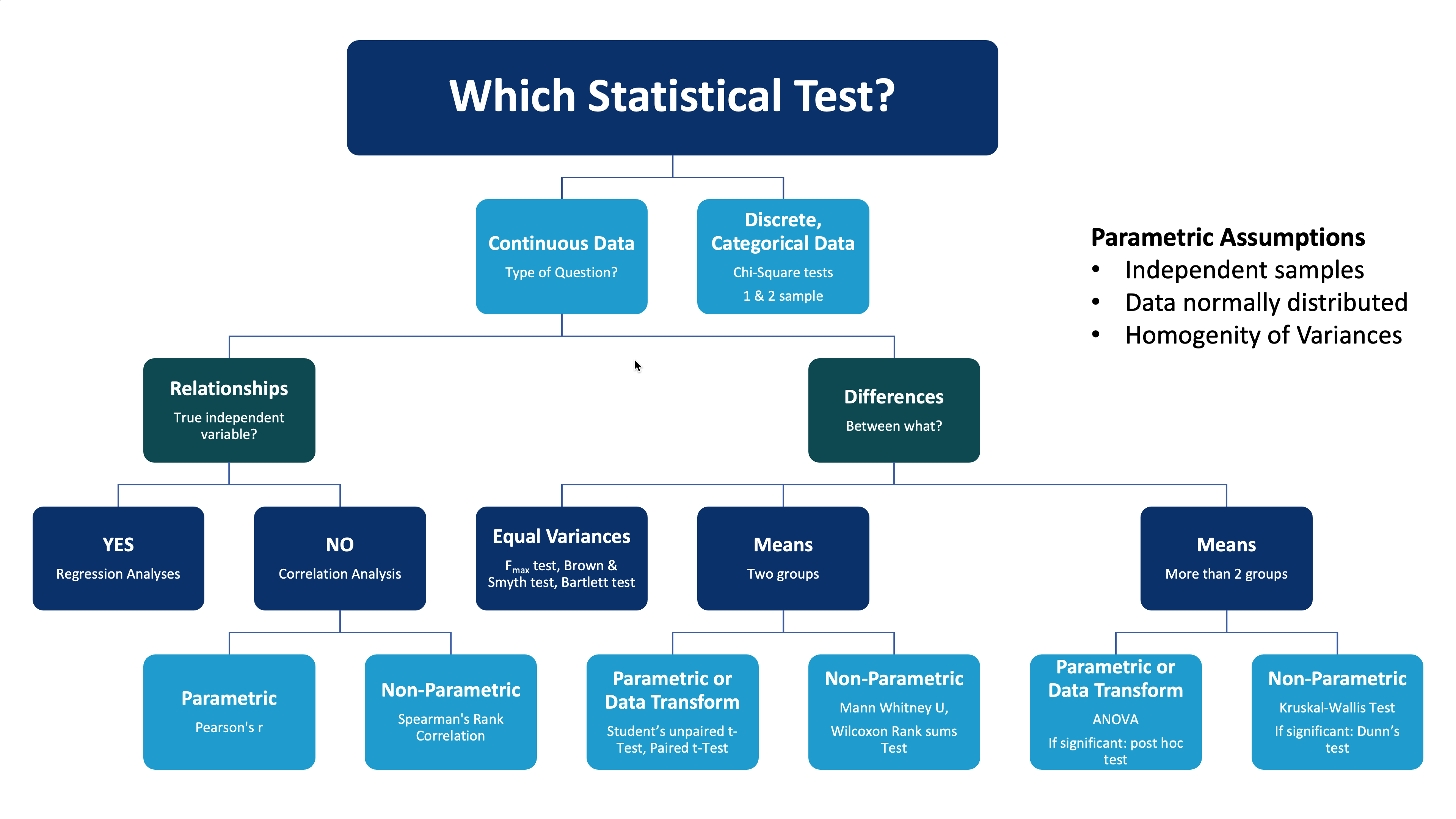
Many statistical tests require that your data meets the parametric assumptions. These assumptions are:
- Independent sample
- Data is normally distributed, which in statistical terms means that the probability distribution of a variable is perfectly symmetrical (no skew) and a kurtosis of 0. To test if data is normally distributed, a Shapiro-Wilk test is carried out. A significant value indicates a deviation of normality and the assumption of normally distributed data has been violated.
- Homogeneity of variances is the assumption that the variance of one variable is stable at all levels of another variable. This is often determined using Levene’s test. If a significant result is found in a Levene’s test, the assumption of homogeneity has been violated.

Efficient HVAC Systems by TU Delft OpenCourseWare is licensed under a Creative Commons Attribution-NonCommercial-ShareAlike 4.0 International License.
Based on a work at https://online-learning.tudelft.nl/courses/efficient-hvac-systems//