


2.8.2 Reflection time
Course subject(s)
Module 2. Calibration and Information score
Calibration and information score in the Classical Model
As mentioned in the previous question, within the Classical Model, the calibration score is valued more than the information score.
That is, it is appreciated that an expert expresses her/his uncertainty appropriately, rather than given very informative, yet very off, assessments. What is the value in experts’ assessments which are consistently underestimating or overestimating?
Reflect on the initial question of the module
This brings you to the place where you can reflect about the first question of this module.
What is the percentage of water in watermelon?
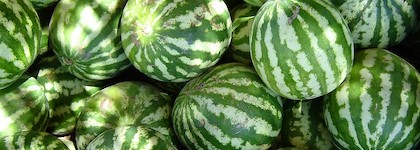
“Watermelons” by Ahmad is licensed under CC BY-NC 2.0
For this, we consult two experts, A and B. Each expert gives their 5%, 50% and 95% quantiles which can be seen in the table below.
| Expert | 5% | 50% | 95% |
|---|---|---|---|
| Expert A | 80 | 90 | 94 |
| Expert B | 93 | 95 | 97 |

Decision Making Under Uncertainty: Introduction to Structured Expert Judgment by TU Delft OpenCourseWare is licensed under a Creative Commons Attribution-NonCommercial-ShareAlike 4.0 International License.
Based on a work at https://online-learning.tudelft.nl/courses/decision-making-under-uncertainty-introduction-to-structured-expert-judgment//.