


0.1.1 About the Course ‘Room for Rivers’
Course subject(s)
Module 0. Welcome to ‘Room for Rivers’
Welcome!
We are very excited to have you on board!
Before we get started, we want to give you some background of the program “Room for the River on which this course is based on and share the experiences from the programme with you, an international audience of learners interested in river management. This course aims to inspire the design of river management programs adjusted to your rivers’ physical, ecological, and political context.
From 2006 till 2018, the Netherlands implemented a Room for the River program to limit flood risks along the Dutch branches of the river Rhine.
The program enriched the long tradition of Dutch river management with new solutions. It was widely considered as hugely successful. The program introduced a trend break on three points:
- Instead of raising the dikes, the program incorporated new flood safety solutions where more room was given to the rivers.
- The program was decentralized, with more responsibility for local partners.
- It introduced spatial quality as a second main goal of the program. It achieved its original objective of limiting flood risks within budget constraints and contributed significantly to the spatial and ecological quality of the Dutch river landscape. The program was cleverly and innovatively designed, ambitions were high, and its success exceeded expectations.

Below you will find an example of an intervention that was part of the Room for Rivers program and the official trailer of the program.
In section 0.2 you will find more information on the course content, learning outcomes and assignments. But first, please introduce yourself in the next unit.
Good luck!
The Room for Rivers course team
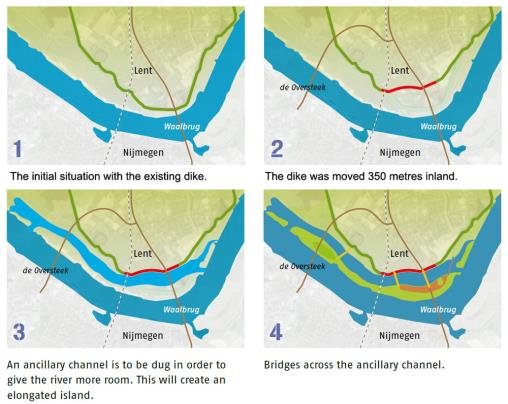
Example of an intervention of the Room for Rivers Program
In the pictures below you will see an example of an intervention that was part of the Room for Rivers Program located near Lent and Nijmegen in the Netherlands.
The initial situation shows the existing dike with a green line. In subsequent situations, the moved dike section is indicated with a red line.
Trailer Room for River Program
If you understand German, we highly recommend this documentary broadcasted in Germany to view as additional material: Raum fur den Fluss

Room for Rivers: Perspectives on River Basin Management by TU Delft OpenCourseWare is licensed under a Creative Commons Attribution-NonCommercial-ShareAlike 4.0 International License.
Based on a work at https://online-learning.tudelft.nl/courses/room-for-rivers-perspectives-on-river-basin-management/.