


2.3 The mechanical energy balance & Bernoulli’s law: exercise 2 (example)
THERMAL BATH IN ICELAND
Imagine you live in Iceland, quite a cold place, and in the weekend you want to relax by visiting a thermal bath. This is a bath heated by warm water from thermal reservoirs heated by the Earth. Your engineering mind, however, doesn’t really come to terms with not knowing what the energy balance is, with respect to describing what such a bath would look like.
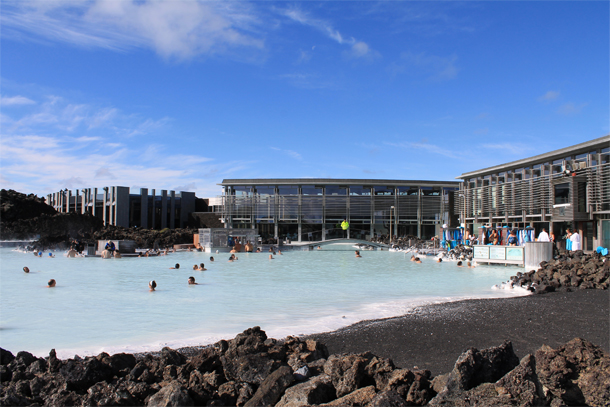
We assume that the thermal bath is ideally mixed, since water flows in at various points of the bath with a flow rate of 100 kg/s. Water flows out at the same flow rate. We take the heat capacity of the water at 4180 J/(kg∙K) and assume it to be constant with temperature. The outside temperature is quite chilly, 5 ⁰C. On the other hand, the inflowing water is quite hot, with a temperature of 70 ⁰C.
To calculate the steady state temperature of the water, we need one more piece of information: the water also loses heat to the environment at a rate which is dependent on the temperature difference between the water and the outside. This relationship can be described as: Φq = h ∙ A ∙ (Twater – Toutside). Let’s assume that we only lose heat to the air and that the wall of the bath is isolated quite well. The area of the pool in contact with the air is 500 m2.
h = 1200 …….?