Important announcement

Dear visitor,

Please note that this OpenCourseWare platform will be replaced at the end of 2026 by a new platform (under the same url ocw.tudelft.nl).

Courses and their contents that are currently available the platform will partly be migrated. URL’s for this content will change and content might be unavailable for some time. In addition, some courses will not be available anymore.

If you are linking to specific courses on this platform (for instance for your students), please take timely measures to avoid problems with access. Possible actions are:

  • Download the materials to your local platform (laptop, server)
  • For educators only (including TU Delft lecturers): Contact us at ocw@tudelft.nl and inform us what course you are using in what context (institute, program, period of use, number of students). We will research (in collaboration with the authors of the course) and decide if we will migrate the course, and if yes, can supply you with a new url.

Thank you.

1.4.4 Stap 3: Controleer je aannames

Course subject(s) Module 1: Inzicht in de gebruikscontext

Stap 3: Controleer je aannames

Terwijl je de mindmap maakt heb je waarschijnlijk aannames gemaakt. Je hebt dingen opgeschreven waarvan je denkt dat je participant ze zou kunnen doen. En dat is goed om je te helpen om te kijken welke onderwerpen je volgende week, tijdens het veldonderzoek, wilt bespreken, maar je moet wel onderscheid maken tussen wat je weet en wat je denkt.

Van sommige van de aannames weet je dat ze waar zijn. Je weet bijvoorbeeld dat je participant (een van je ouders, een oom/tante, of een vriend of collega van je ouders) ergens in de ochtend wakker wordt. (Tenzij ze nachtdiensten draaien natuurlijk!). Wat je waarschijnlijk niet zeker weet is hoe vaak ze bijvoorbeeld de snooze-knop indrukken, in welke volgorde ze hun ochtendritueel uitvoeren of hoe ze zich voelen gedurende de ochtend.

Let op: dit is nog steeds voorbereiding op je afspraak met de participant, dus bespreek nog niks met hem/haar.

Instructies

  1. Zet in je mindmap een (A) bij alle dingen die je zeker weet. Zet een (B) bij alle aannames en verwachtingen waar je niet zeker van bent, maar die je wel belangrijk of interessant vindt om te bespreken met je participant. Die laatste categorie kunnen bijvoorbeeld problemen of worstelingen zijn waarvan je denkt dat je participant die heeft. Problemen en worstelingen kunnen namelijk een goede inspiratiebron zijn voor je ontwerp.
  2. Schrijf op blad 2 van het werkbladenpakket de aannames op waar je het meest en het minst zeker van bent, en waarom dat zo is.

Voorbeeld blad 2 stap 3: Controleer je aannames
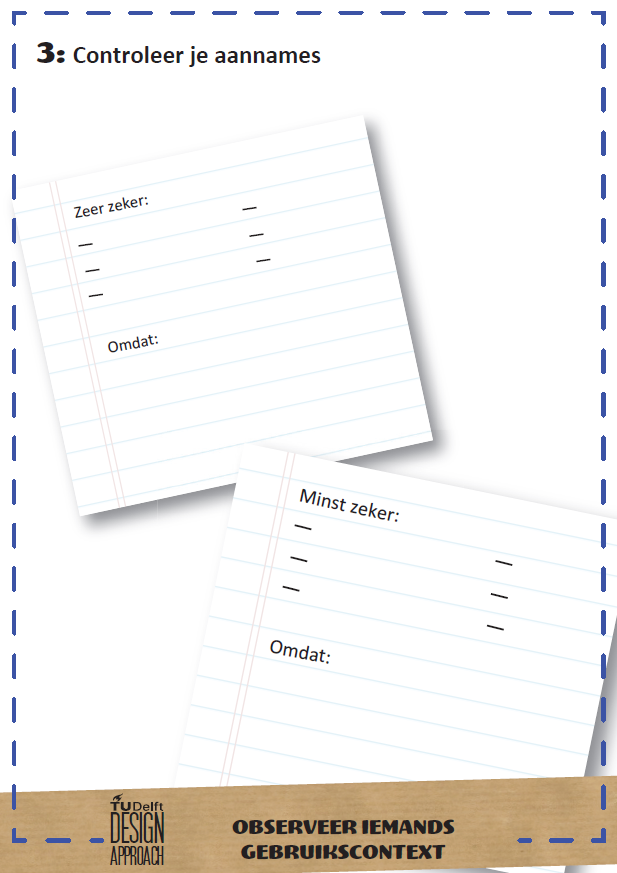
Opdracht 1 blad 2

Creative Commons License
Introductie productontwerpen: van probleem tot prototype by TU Delft OpenCourseWare is licensed under a Creative Commons Attribution-NonCommercial-ShareAlike 4.0 International License.
Based on a work at https://online-learning.tudelft.nl/courses/delft-design-approach/
Back to top
[sg_popup id=6]