Important announcement

Dear visitor,

Please note that this OpenCourseWare platform will be replaced at the end of 2026 by a new platform (under the same url ocw.tudelft.nl).

Courses and their contents that are currently available the platform will partly be migrated. URL’s for this content will change and content might be unavailable for some time. In addition, some courses will not be available anymore.

If you are linking to specific courses on this platform (for instance for your students), please take timely measures to avoid problems with access. Possible actions are:

  • Download the materials to your local platform (laptop, server)
  • For educators only (including TU Delft lecturers): Contact us at ocw@tudelft.nl and inform us what course you are using in what context (institute, program, period of use, number of students). We will research (in collaboration with the authors of the course) and decide if we will migrate the course, and if yes, can supply you with a new url.

Thank you.

2.1.1 introduction to Searching & Evaluating

Course subject(s) 2. Searching & Evaluating
 Time estimation: 35 min.

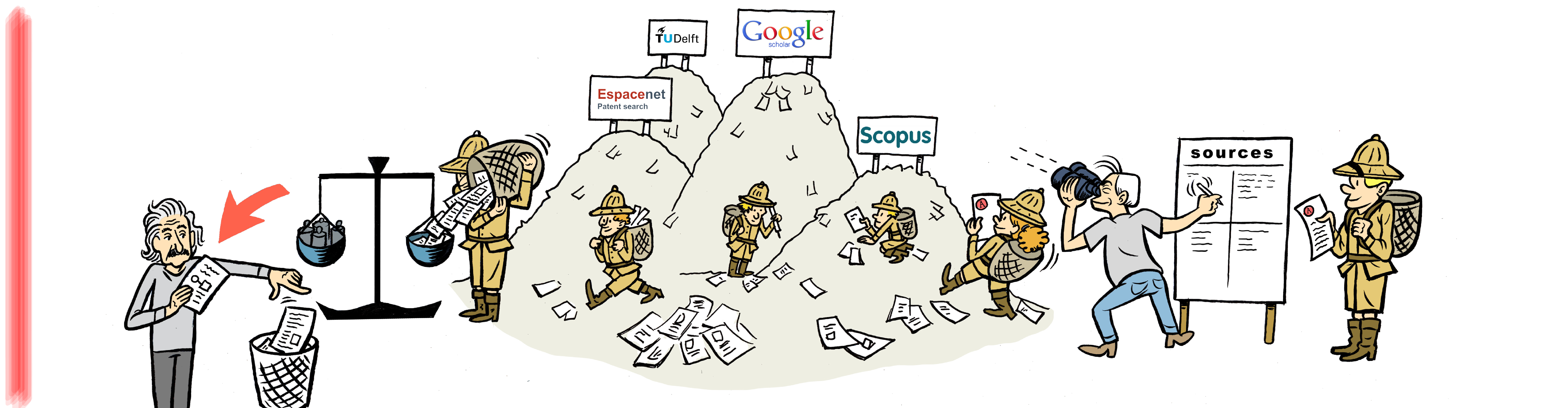
After formulating your concepts, synonyms and related terms, you still need to determine what kind of information you are looking for, which information source you should use and how to search in this information source. You need to determine what information you are looking for and where you are going to search. Then you can create a search query for your search plan.

While searching, you will evaluate your search query based on the (expected) number of search results and the relevance of these results. You check the reliability by evaluating the scientific nature of the results. It is an iterative process, so modify your search query and research question where necessary.

Topics in this module:

  • Information sources
  • Searching
  • Reliability

Make sure you read the relevant TUlib modules:

Type of information and resources to use

Resources

Search operators

Back to top
[sg_popup id=6]