


2.1.1 What is module 2 of Building Inclusive Cities about?
Course subject(s)
2. The Vicious Circle of Segregation
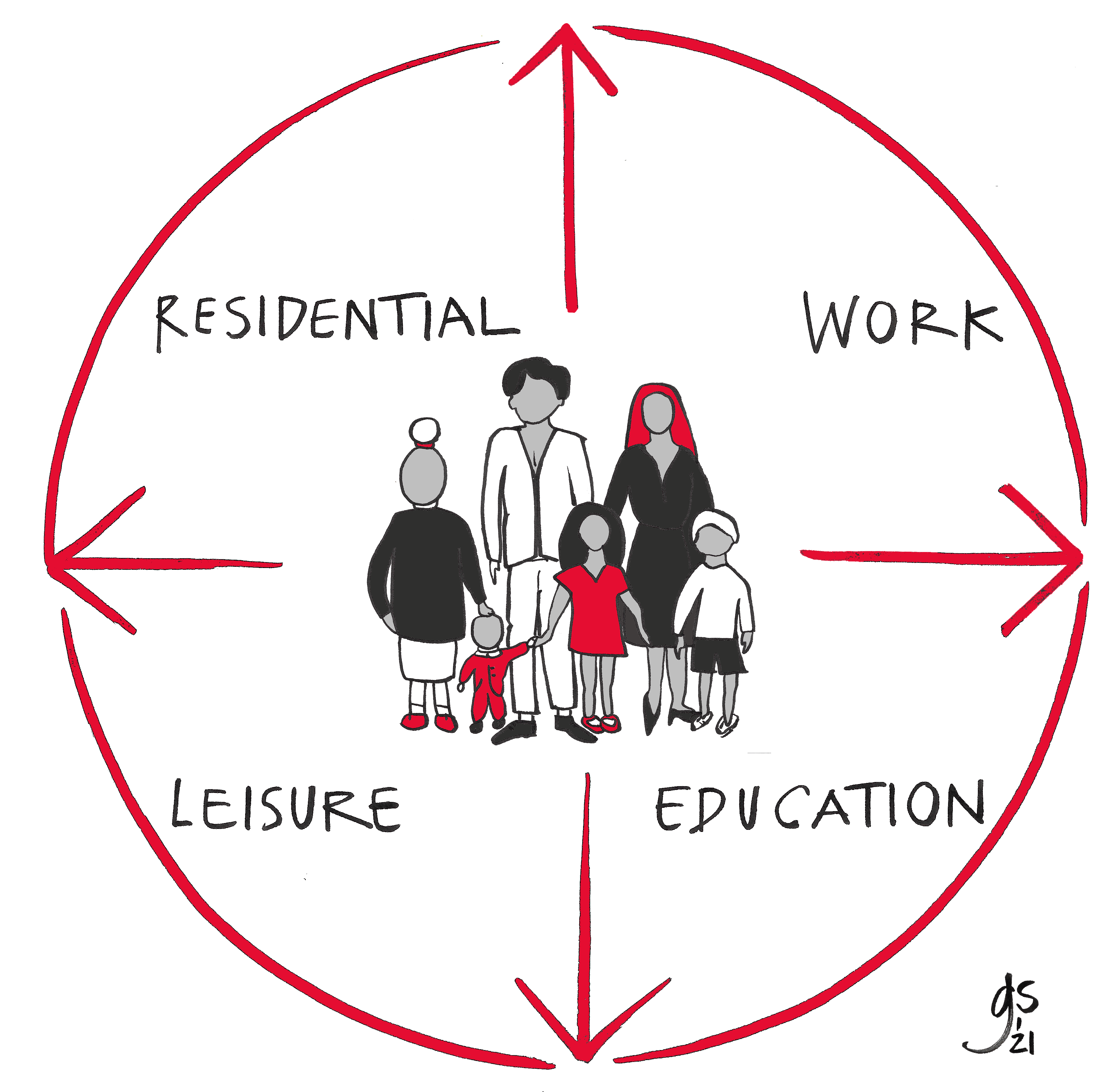
Illustration by G. Sanders, CC BY-NC-ND 4.0
You are very welcome to the second module of Building Inclusive Cities! In the next few units you will find out that there are many ways to measure inequality and segregation and you will learn how to interpret the most commonly used indices.
We will then focus on the connectedness of segregation in different domains of daily life: places of residence, work, schools and during leisure time. The concept of a vicious circle of segregation helps us to understand these connections. We will further discuss the role of inequality in producing and reproducing segregation, and how place-based, people-based, and connectivity-based policy responses can help to break this circle.
You will also learn how urban design interventions can help to reduce spatial inequality in cities. We will provide you with many examples to help you understand the effect of these different interventions.

Building Inclusive Cities: Tackling Urban Inequality and Segregation by TU Delft OpenCourseWare is licensed under a Creative Commons Attribution-NonCommercial-ShareAlike 4.0 International License.
Based on a work at https://online-learning.tudelft.nl/courses/building-inclusive-cities-tackling-urban-inequality-and-segregation/