


3.1.4 Your Favourite Shearing Layer
Course subject(s)
Module 3. Building
In the previous video, you learned that to apply circular economy principles to the construction of buildings, we first need to understand the organization of a building structure and the life-cycle of its various layers.
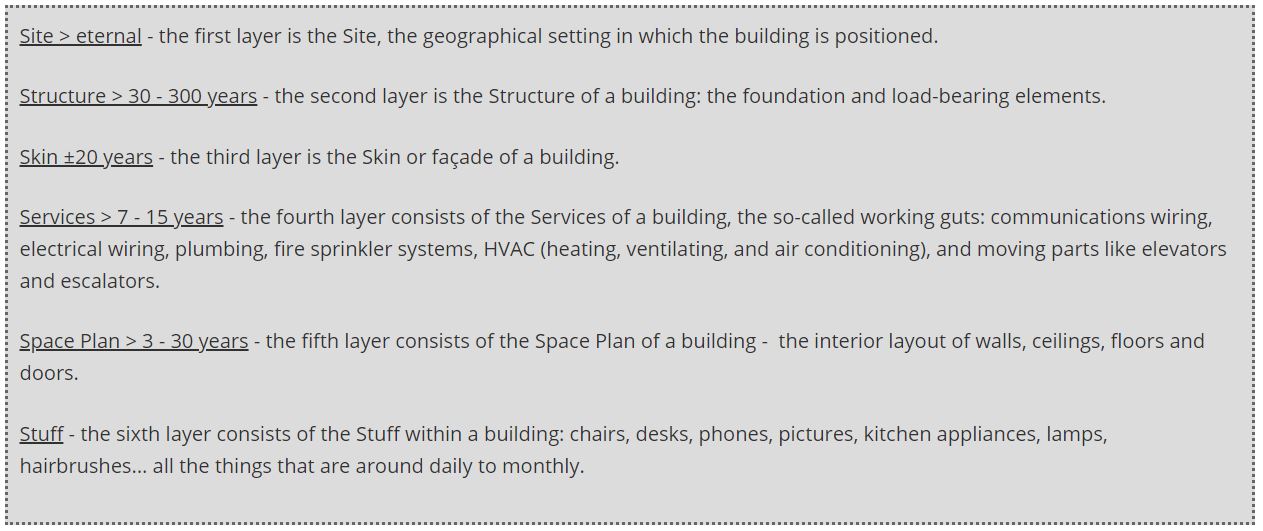
To unfold the complexity of a building we will use the “Shearing Layers” concept of architect Frank Duffy, which was later elaborated by Stewart Brand in his book How Buildings Learn: What Happens After They’re Built (1994), which refers to buildings as composed of several layers of change.
Duffy and Brand identified the following shearing layers to structure the organization of a building (quoted from Brand):
Now that you understand that a building is not one object, but a collection of shearing layers, it might be easier to think of a resource reduction strategy during the design process.

Circular Economy for a Sustainable Built Environment by TU Delft OpenCourseWare is licensed under a Creative Commons Attribution-NonCommercial-ShareAlike 4.0 International License.
Based on a work at https://online-learning.tudelft.nl/courses/circular-economy-for-a-sustainable-built-environment//.