Important announcement

Dear visitor,

Please note that this OpenCourseWare platform will be replaced at the end of 2026 by a new platform (under the same url ocw.tudelft.nl).

Courses and their contents that are currently available the platform will partly be migrated. URL’s for this content will change and content might be unavailable for some time. In addition, some courses will not be available anymore.

If you are linking to specific courses on this platform (for instance for your students), please take timely measures to avoid problems with access. Possible actions are:

  • Download the materials to your local platform (laptop, server)
  • For educators only (including TU Delft lecturers): Contact us at ocw@tudelft.nl and inform us what course you are using in what context (institute, program, period of use, number of students). We will research (in collaboration with the authors of the course) and decide if we will migrate the course, and if yes, can supply you with a new url.

Thank you.

Hollow vs. Solid Shaft

Course subject(s) 3. Torsion

An engineer is asked to size a 3 m long aluminum shaft designed to transmit a torque of 1200 Nm. The engineer has the following two design constraints and two design options:

Design Constraints:

  • Maximum allowable shear stress within the shaft = 40 MPa
  • Maximum allowable twist = 0.75 deg/m
  • G = 78 GPa

Design Options:

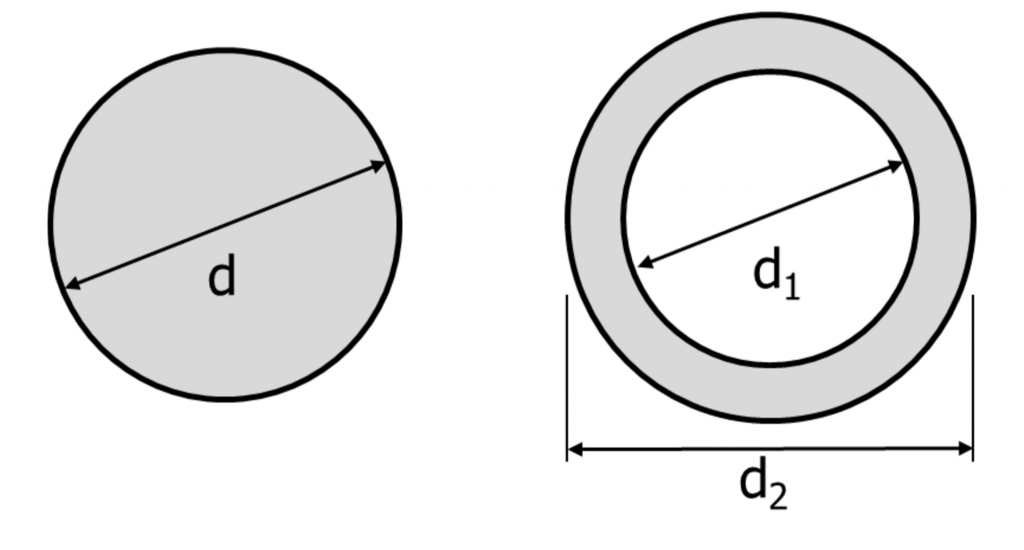
  • Solid circular shaft cross-section of diameter d
  • Hollow circular shaft with outer diameter d2 and wall thickness of 10% d2
Questions:

  1. Which shaft design will be more weight efficient and why?
  2. What is the minimum diameter, d, of the solid shaft?
  3. What is the minimum outer diameter, d2, of the hollow shaft?
Creative Commons License
Aerospace Mechanics of Materials by TU Delft OpenCourseWare is licensed under a Creative Commons Attribution-NonCommercial-ShareAlike 4.0 International License.
Based on a work at https://ocw.tudelft.nl/courses/aerospace-mechancis-of-materials/.
Back to top
[sg_popup id=6]