Important announcement

Dear visitor,

Please note that this OpenCourseWare platform will be replaced at the end of 2026 by a new platform (under the same url ocw.tudelft.nl).

Courses and their contents that are currently available the platform will partly be migrated. URL’s for this content will change and content might be unavailable for some time. In addition, some courses will not be available anymore.

If you are linking to specific courses on this platform (for instance for your students), please take timely measures to avoid problems with access. Possible actions are:

  • Download the materials to your local platform (laptop, server)
  • For educators only (including TU Delft lecturers): Contact us at ocw@tudelft.nl and inform us what course you are using in what context (institute, program, period of use, number of students). We will research (in collaboration with the authors of the course) and decide if we will migrate the course, and if yes, can supply you with a new url.

Thank you.

Introduction

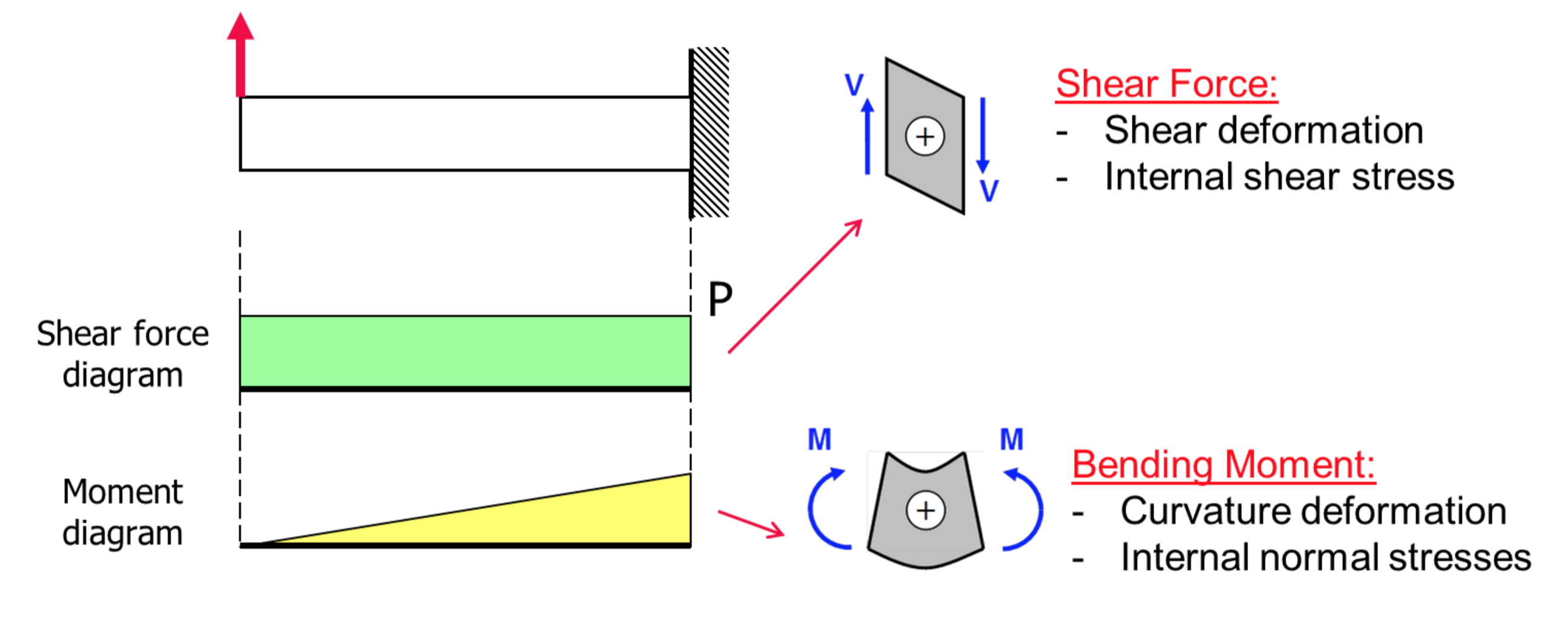
In the previous unit, we examined the normal stresses that develop in beams due to internal moment loading. In most beam problems, however, there is internal shear force loading as well. In this unit, we will examine the behaviour of a beam in response to this internal shear force loading.
Learning Objectives1

By the end of this unit, students should be able to…

  • Explain the derivation of the transverse shear formula
  • Apply the transverse shear formula to calculate shear stress/strain distributions in beam sections
  • Explain the limitations of the transverse shear formula and identify beam sections for which its use is inappropriate
  • Calculate shear flow distributions in thin-walled beam sections due to transverse shear
Back to top
[sg_popup id=6]