


1.6.2 How does the Carver EV work?
Course subject(s)
Module 1. How does an EV work?
The table below shows the key specializations of the Carver EV. It is interesting to note the top speed of the vehicle is 45km/h and has a WLTP range of 75km. The Carver uses a 5.4kWh battery that powers two motors of 2 kW each. Due to the lower energy capacity of the battery, the EV uses low voltage batteries upto 60V.
| Vehicle classification | |
| EU | L2e |
| Dimensions | |
| Length, Height, Width (incl. side mirrors) | 2.89 m, 1,49m, 1.09m |
| Unladen & Max. permissible mass | 260 kg, 500 kg |
| Luggage compartment | 75 |
| Number of wheels | 3 |
| Performance | |
| Top speed | 45 km/h |
| Acceleration 0-45 km | 8 sec |
| Turning circle | 7.1 m |
| Range (WLTP) | 75 km |
| Range (45 km/h) | 100 km |
| Electric Motors | |
| Type | In wheel motor |
| Max power | 2 x 2 kW |
| Max torque | 2 x 150 Nm |
| Battery | |
| Battery type | Lithium Iron phosphate |
| Battery capacity | 3.8 kWh, 60V |
| Charging time 100% | 6.5 h |
In this block diagram, you can see the layout of the components in a Carver electric vehicle.
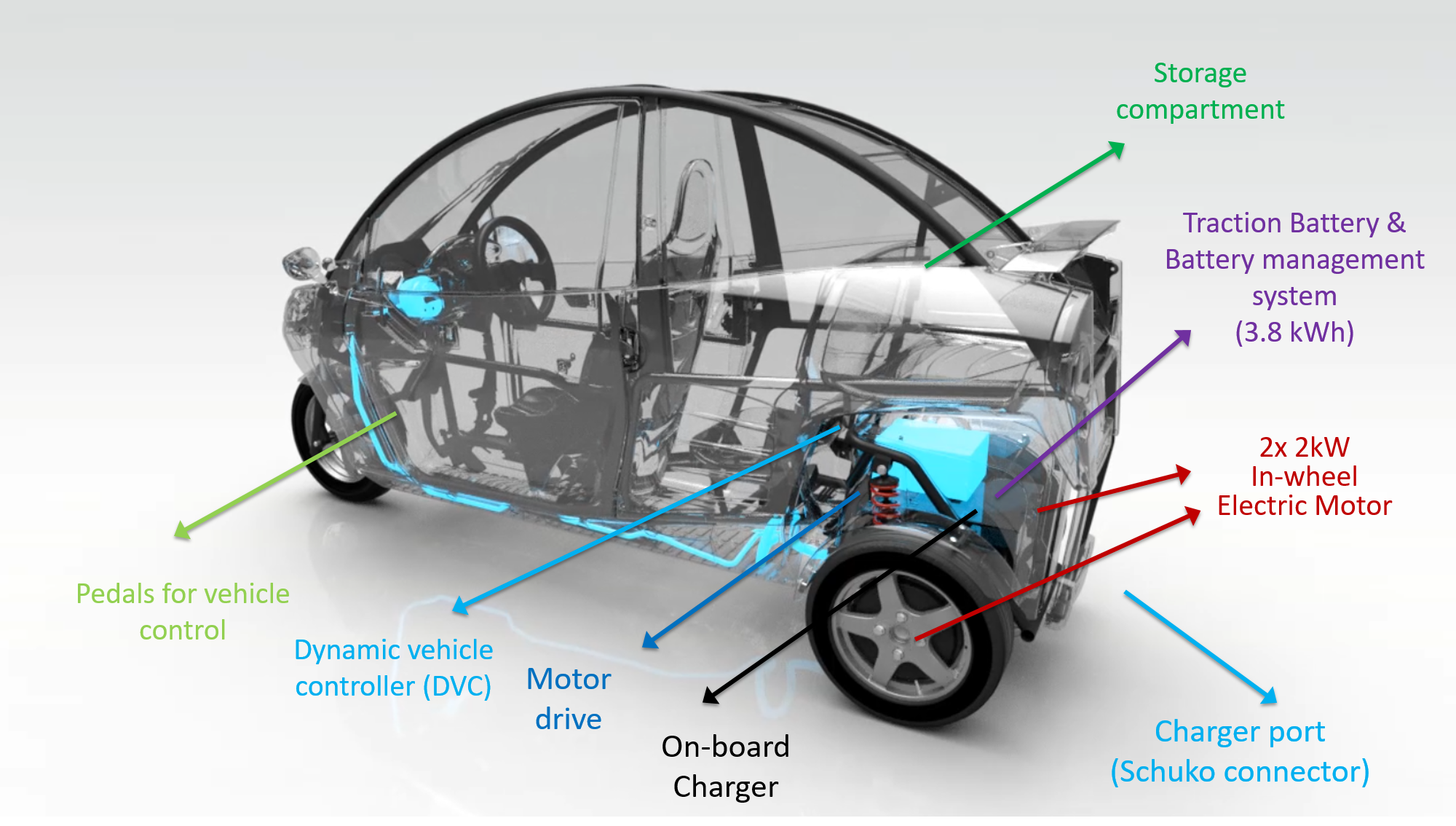
We can see the 5.4 kWh battery and battery management system is located in the back of the car, between the 2 wheels. The motors, 2 kW each, are located inside the wheels. These are referred to as in-wheel or hub motors.

In the following video, we will see Chris present the structure of a Carver electric car.
In this video, we asked Chris van den Brink, technical director of Carver why you should switch to EVs, how Carver differs from other electric vehicles, Carver’s use scenarios and more.
Interview : Carver EV

Electric Cars: Technology by TU Delft OpenCourseWare is licensed under a Creative Commons Attribution-NonCommercial-ShareAlike 4.0 International License.
Based on a work at https://online-learning.tudelft.nl/courses/electric-cars-technology/.