


6.3.5 Main Takeaways on Stress and Strain Concentrations
Course subject(s)
Module 6. Certification, Fatigue, and Durability
Stress Concentration Factor
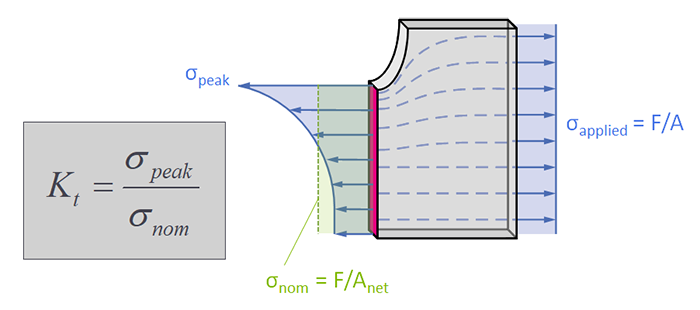
The stress concentration factor, 𝐾𝑡, is defined as the ratio of the peak stress divided by the nominal (or average) stress along a specific cutting plane within a structure. This is illustrated below for a stress concentration in flat plate with an elliptical notch.
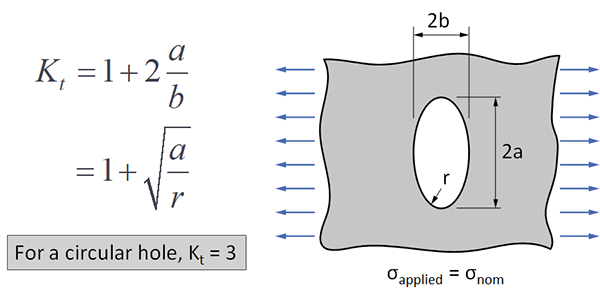
Kt for an Elliptical Hole in an Infinite Plate
An infinite plate is a convenient theoretical structural case to consider as in such a plate, the nominal and applied stresses are equal due to the fact that A=Anet in the case of an infinite width of the plate. For such a case, a simple analytical solution for the stress concentration factor can be obtained, allowing the influence of the notch shape on Kt to be easily understood.
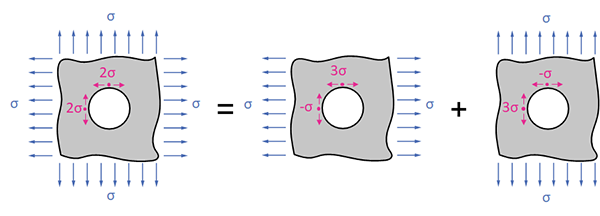
Superposition
If the stress state is linear elastic, the principle of superposition can be applied to obtain solutions for complex loading based on known solutions for less complex loading, as long as those solutions sum to the complex loading scenario.

Introduction to Aerospace Structures and Materials by TU Delft OpenCourseWare is licensed under a Creative Commons Attribution-NonCommercial-ShareAlike 4.0 International License.
Based on a work at https://online-learning.tudelft.nl/courses/introduction-to-aerospace-structures-and-materials/.