


What is modelling
Course subject(s)
Module 5: Modelling Complexity
Welcome to module 5! You’ve been introduced to infrastructures, and the complex systems perspective. You now know wat complexity is and why – because of this- , it so difficult to design/define policies (for example, an energy transition process).
However, there is one powerful tool which may help us to analyse complex policy questions: modelling. Why has modelling become so popular? Well, it enables strategic advisors and policy-makers to build policy models of complex issues, simulate their long-term dynamics, identify effective policies to deal with these issues, and test their robustness. The Polio eradication program of the World Health Organization (WHO) and the Portland City Plan are examples of how system dynamics helped governments and other bodies to determine an appropriate course of action.
This week we will learn more about the potential of modelling, which is something people involved in infrastructure systems love to do; think of designers, policymakers and researchers.
Actually, some might say modelling is something we all do, all the time. Think about it. In essence modelling is nothing more than an attempt at making the world all around us a bit easier to understand. We’re essentially trying to get some sort of grip on reality. So modelling consists of defining a number of variables and the relations between them, for example. That’s modelling. Drawing a mind map of concepts and theories that have relationships with each other (as the one below) – that’s modelling too. So modelling has many faces. And this week we’re going to take a good look at the faces that are most pertinent when you want to model complex infrastructure systems.
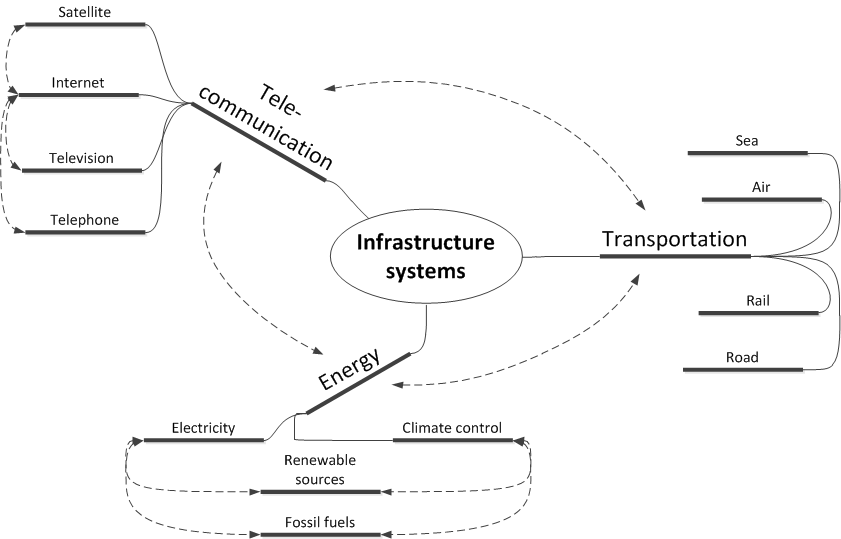
A simple ‘modelling’ example: a mind map of infrastructure systems

Next Generation Infrastructures by TU Delft OpenCourseWare is licensed under a Creative Commons Attribution-NonCommercial-ShareAlike 4.0 International License.
Based on a work at https://ocw.tudelft.nl/courses/next-generation-infrastructures/.